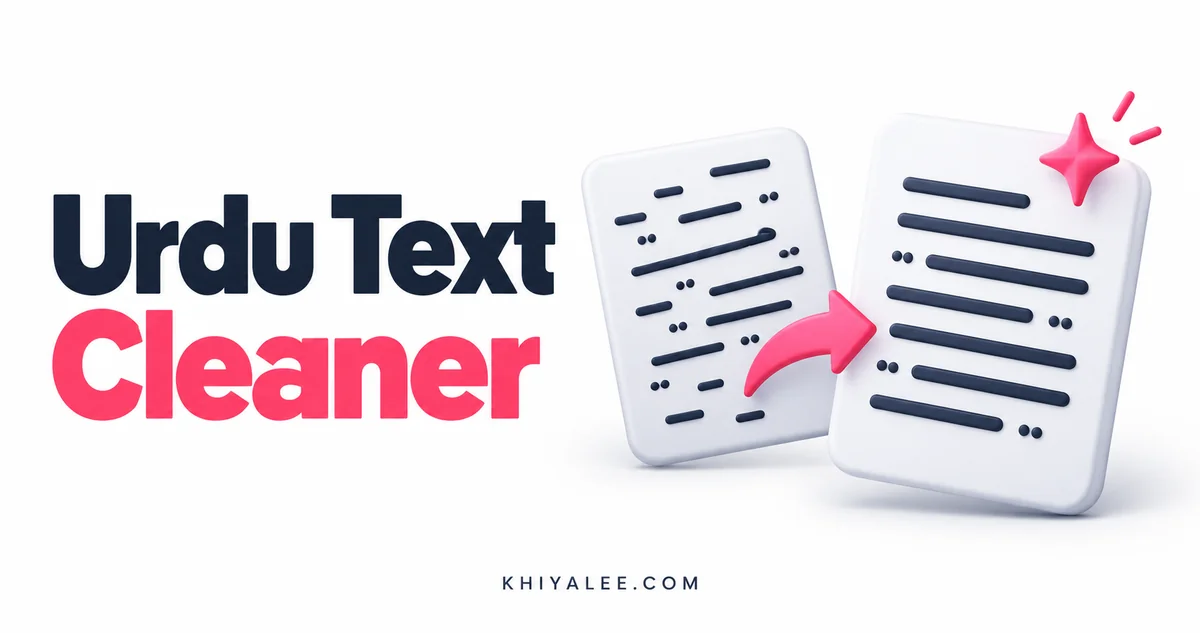
You can remove extra spaces from Urdu text to tidy a copied passage, caption or document. The important step is to distinguish accidental whitespace from meaningful paragraph breaks and joining characters. This guide shows a careful cleanup workflow that preserves an original copy for comparison.
Try the free tool
Urdu Text Space Cleaner: Remove Extra Spaces
Try it: Open the related Khiyalee tool while following the examples below.
In this guide
- Identify the spacing problem first
- Try a small sample before a long document
- Preserve letters, marks and joining behavior
- Handle PDF line breaks carefully
- Proofread after pasting into the final layout
Identify the spacing problem first
Repeated spaces, empty lines and spaces at the start or end of a passage are different problems. A copied PDF may contain line breaks after every visual line, while a typed message may contain only a few accidental gaps. Decide what needs changing before applying a cleanup option. Removing every whitespace character would join words together and make the text harder to read.
Try a small sample before a long document
Paste a short paragraph with the same problem into the Urdu space cleaner. Compare the before and after versions. For example, two accidental spaces between words can usually become one, but a paragraph break may need to remain. Testing a representative sample makes it easier to see whether a selected option matches your intention.
Preserve letters, marks and joining behavior
Urdu writing relies on connected letter shapes and can contain diacritics or other text characters. These are not interchangeable with ordinary spaces. Do not remove unfamiliar invisible characters indiscriminately, especially if the appearance of the words changes. After cleaning, read the passage in a font that supports Urdu properly and compare it with the original.
Handle PDF line breaks carefully
A line break after every short line may be an artifact of copying from a PDF. Joining those lines can restore a paragraph, but real headings, list items and separate paragraphs should remain distinct. Review the structure rather than choosing the most aggressive cleanup. For quotations, poetry or carefully formatted religious text, line breaks may be intentional and should not be discarded automatically.
Proofread after pasting into the final layout
A text cleaner fixes spacing, not spelling, punctuation or meaning. Paste the result into the actual editor or design file and inspect direction, alignment and line wrapping. Keep the original until the final version is approved. If you also need a word count or digit conversion, perform those as separate steps so any unexpected change is easier to identify.
How to use the tool: step by step
- Keep an unchanged copy of the original Urdu passage.
- Paste a sample into the cleaner and select the relevant spacing option.
- Compare word boundaries and paragraph structure.
- Clean the full text, then proofread it in the destination layout.
Frequently asked questions
Will the cleaner correct Urdu spelling?
No. Spacing cleanup should not be treated as spelling or grammar correction.
Should I remove all blank lines?
Only if they are accidental. Blank lines may separate paragraphs or sections.
Can I clean a Quranic passage automatically?
Use particular care and compare against an authoritative original. Do not assume a spacing tool verifies the text or its diacritics.
Remove extra spaces from Urdu text: try the tool
Open the working tool to apply this guide to your own inputs. For the next part of your workflow, explore Urdu & English Word Counter: Words and Characters, or browse the complete tools directory.
Ready to try it? Open the tool and follow the steps in this guide.