
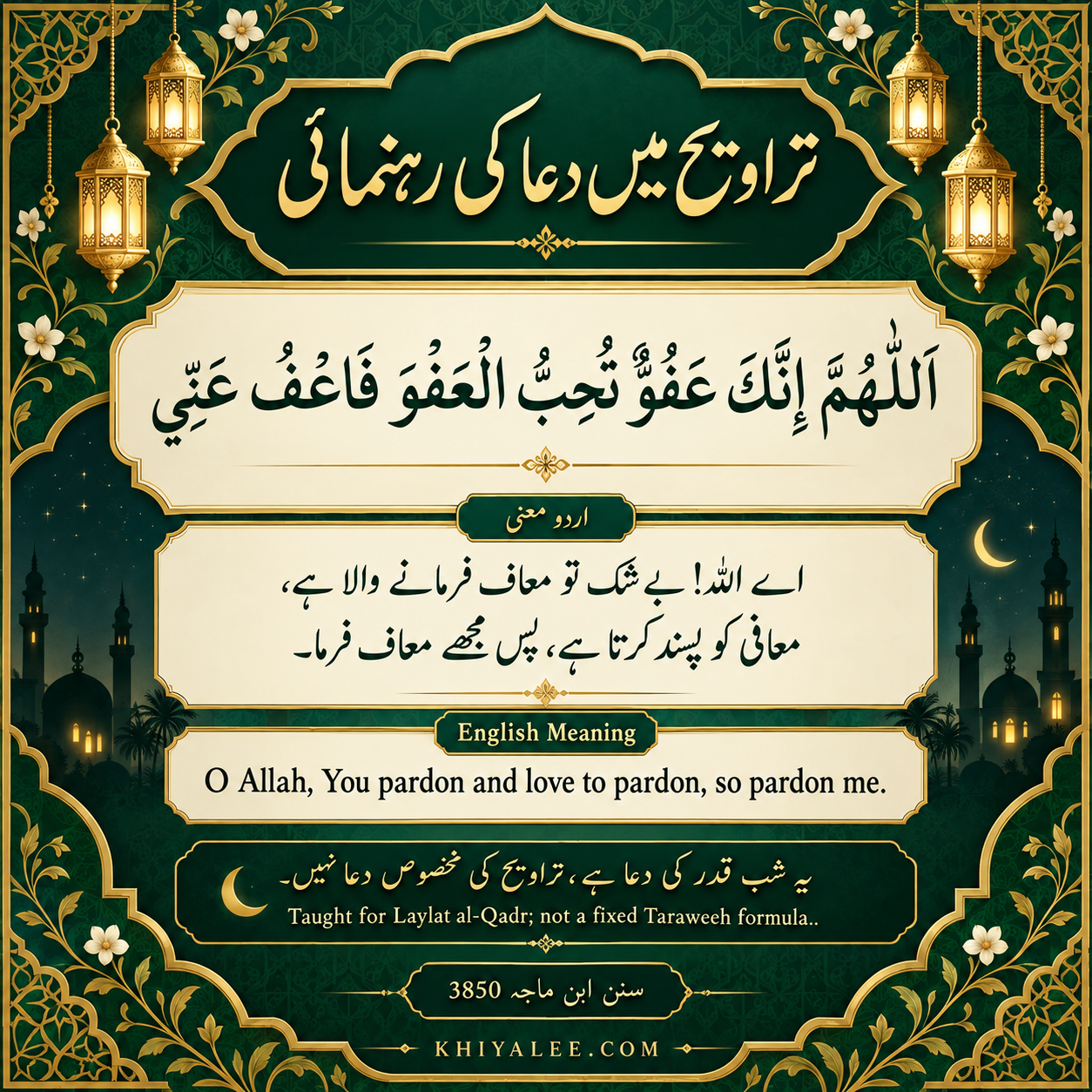
There is no single compulsory Taraweeh dua after every four rakahs. The Hanafi guidance linked below explains the choices during the rest. The Arabic prayer on this page, Allahumma innaka afuwwun, was taught for Laylat al-Qadr in Sunan Ibn Majah 3850; it should not be labelled a fixed Taraweeh formula.
Taraweeh Dua: Arabic Text and Its Context
اللَّهُمَّ إِنَّكَ عَفُوٌّ تُحِبُّ الْعَفْوَ فَاعْفُ عَنِّي
Urdu meaning
اے اللہ! بے شک تو معاف فرمانے والا ہے، معافی کو پسند کرتا ہے، پس مجھے معاف فرما۔
English meaning
O Allah, You pardon and love to pardon, so pardon me.
Transliteration
Allahumma innaka afuwwun tuhibbul-afwa fa‘fu anni.
Reference: Sunan Ibn Majah 3850 — taught for Laylat al-Qadr. Translations are explanatory renderings of the meaning.
Is there one required Taraweeh dua?
A particular dua should not be presented as obligatory after every four rakahs. Shaykh Waseem Khan’s Hanafi explanation describes a choice during the rest, including individual remembrance, Quran recitation or remaining silent. It distinguishes this from claiming that one congregational formula must be recited.
What about Subhana dhil-mulki wal-malakut?
The longer tasbih beginning with these words is familiar in many South Asian mosques. The cited Hanafi explanation discusses its appearance in fiqh works and optional individual recitation. Its familiarity does not establish it as a compulsory component of Taraweeh or a fixed prophetic formula after each four rakahs.
Why this image shows a prayer for pardon
The wording Allahumma innaka afuwwun is recorded in Sunan Ibn Majah 3850, graded sahih on the cited source. Aishah asked what to say on Laylat al-Qadr, and this prayer was the answer. That is its reported context. The poster explicitly says that it is a Laylat al-Qadr supplication, not a fixed Taraweeh formula.
Understanding the words
The dua recognises Allah’s pardon, His love of pardoning, and our own need to be forgiven. Keeping its meaning close makes a short prayer easier to learn thoughtfully. The transliteration can help beginners, but the Arabic remains the reference text.
Sharing a Taraweeh dua image responsibly
Keep the source line and explanatory note visible. Avoid adding claims that every worshipper must say this after four rakahs, or that a special number of repetitions guarantees forgiveness. For the practice of your congregation, ask its qualified imam and preserve courtesy toward other worshippers.
Dua Image and Related Reading
Related reading: Dua Masoora with Urdu and English meanings.
Frequently asked questions
Do I have to read one fixed dua after four rakahs?
The cited Hanafi explanation does not make one specific formula mandatory during the rest.
Is Allahumma innaka afuwwun specifically a Taraweeh dua?
Its reported teaching in Sunan Ibn Majah 3850 concerns Laylat al-Qadr. The article and image keep that context clear.
Can I share this poster for Ramadan?
Yes. Keep the reference and the note about its original context with the image.
More duas to read
Continue learning with Islamic duas in Arabic with Urdu translation and Rabbana Atina Fid Dunya.