
Roza kholnay ki dua shown here begins Dhahabaz-zama’u wabtallatil-‘uruq. It describes thirst passing and hope for Allah’s reward when breaking the fast. The wording comes from Sunan Abi Dawud 2357, graded Hasan by Al-Albani in the cited edition.
Roza Kholnay Ki Dua in Arabic
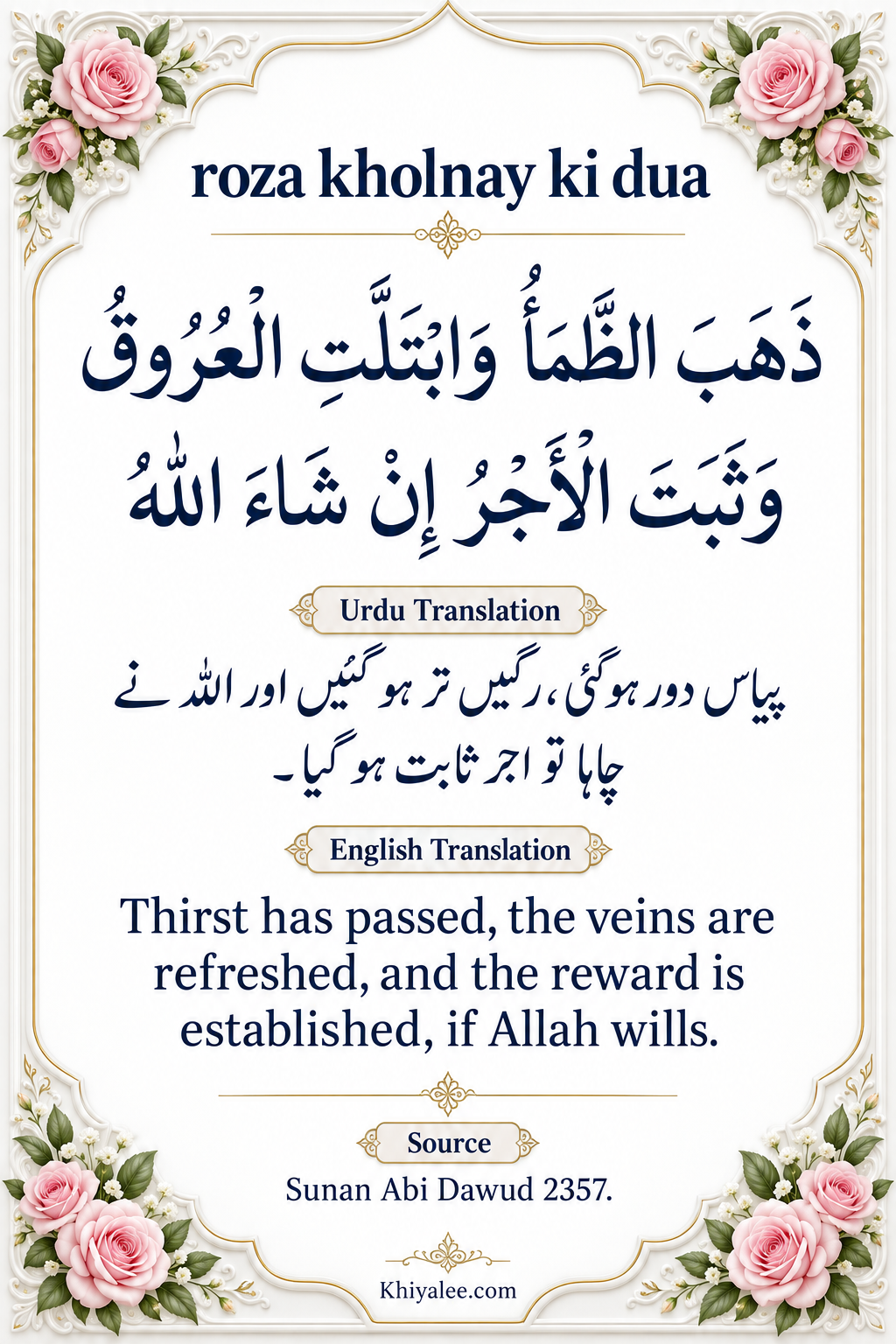
ذَهَبَ الظَّمَأُ وَابْتَلَّتِ الْعُرُوقُ وَثَبَتَ الْأَجْرُ إِنْ شَاءَ اللَّهُ
Urdu Translation
پیاس دور ہو گئی، رگیں تر ہو گئیں اور اللہ نے چاہا تو اجر ثابت ہو گیا۔
English Translation
Thirst has passed, the veins are refreshed, and the reward is established, if Allah wills.
Frequently Asked Questions
When is this iftar dua said?
The narration describes the Prophet ﷺ saying it when he broke his fast. Its words refer to thirst having passed and the veins being refreshed.
Is this a dua for intending to fast?
No. It is associated with breaking the fast, rather than expressing an intention to begin fasting.
What does in sha Allah mean in this dua?
It means “if Allah wills.” In this wording it accompanies the statement about the reward being established.
Dua Image and Related Reading
Related reading: Dua Masoora in Arabic with Urdu and English Translation · Hajat Ki Dua: A Quranic Prayer with Urdu and English Meaning
Meaning and When to Read
The dua acknowledges relief after fasting and expresses hope in Allah’s reward. Its wording refers to thirst having passed and the body being refreshed, so the meaning is especially clear when read at iftar.
The narration describes the Prophet ﷺ saying these words when he broke his fast. This page follows Sunan Abi Dawud 2357, graded Hasan by Al-Albani on the cited source.
Reference: Sunan Abi Dawud 2357.
This is an iftar supplication, not a fasting-intention formula. The image and text use the same sourced wording without combining it with other popular versions.
Explore more good morning duas in Urdu and our morning dua for happiness.
Roza Kholnay Ki Dua Transliteration
Dhahabaz-zama’u wabtallatil-‘uruqu wa thabatal-ajru in sha Allah.
Roman letters are a learning aid. They cannot show every Arabic sound precisely, so compare each phrase with the Arabic above and ask a competent Arabic reader to help with pronunciation.
A Simple Way to Learn the Iftar Dua
- Read the Arabic slowly in short sections instead of trying to memorise the whole line at once.
- Read the Urdu meaning after each section, then compare it with the English meaning.
- Cover the transliteration and try reading the Arabic on its own. If a word is difficult, return to it without rushing.
- Keep a copy of the image available for reading at iftar. The source reference helps you find the original report later.
This is a practical learning routine, not a prescribed religious method or a required number of repetitions. Choose a pace that helps you understand the words.
Sharing the Dua with Family
When forwarding a roza kholnay ki dua image on WhatsApp, include the Arabic, translation and reference together. A short caption can explain that it is an iftar supplication, so a reader does not confuse it with a sehri intention.
Keep the original proportions when saving the poster. Cropping the bottom of an image can remove its reference, while stretching it can make Arabic marks difficult to read. Open the image at full size if your phone preview is too small.
The English and Urdu lines explain the meaning; they are not additions to the Arabic prayer. Read whichever translation is easiest for you, and return to the Arabic text when learning the wording.